Research

My research is currently funded by the project below. It runs along two connected lines: the transport properties of dense matter in neutron stars and their mergers, and the behaviour of nuclear matter at high temperature.


Funded project

Effective theories of strong nuclear interactions under extreme conditions (xQCD)

ReferencePID2025-168786NB-I00
FunderSpanish State Research Agency (AEI)
RolePrincipal investigator
Quantum Chromodynamics (xQCD) Dense nuclear matter Gravitational-wave astrophysics High-temperature QCD plasma
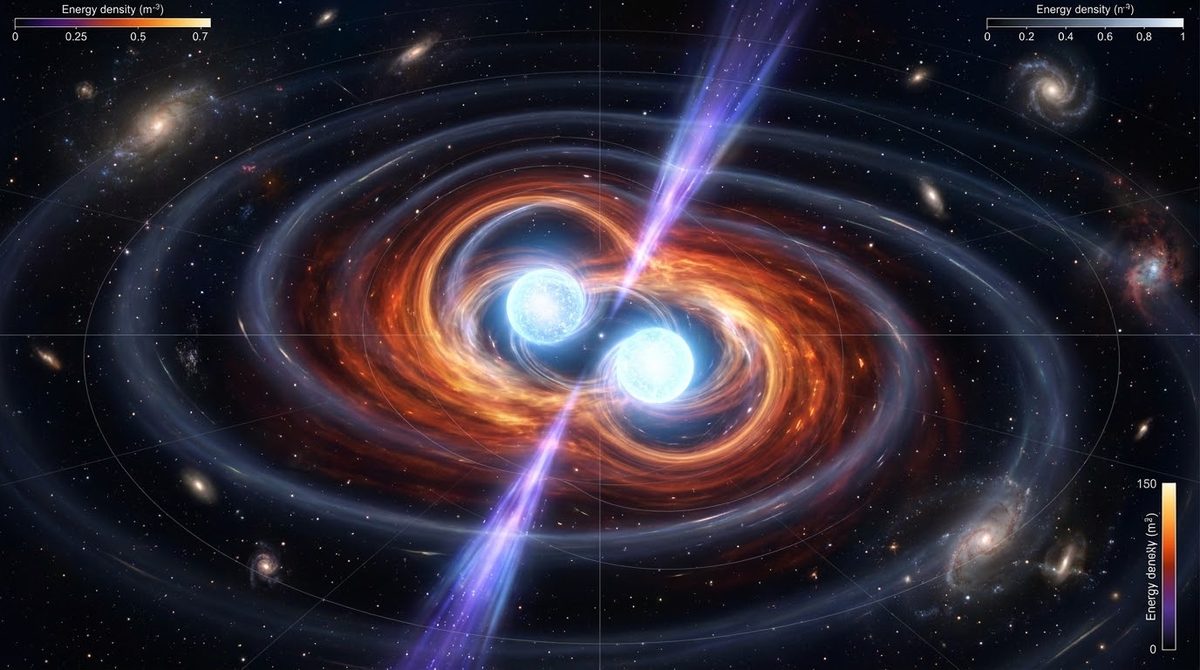
Illustration of two neutron stars spiralling together, surrounded by rings of hot debris and a jet along the rotation axis.

Astrophysics and nuclear matter

Transport properties in neutron stars and neutron star mergers

Understanding how dense nuclear matter behaves — specifically transport properties like viscosity and thermal conductivity — is essential for unlocking the mysteries of neutron stars. While a star’s mass and size are governed by its basic equation of state, its transport properties dictate how it reacts to external forces, offering vital clues about its hidden microscopic makeup, which could range from standard protons and neutrons to exotic quarks.

Because we cannot replicate these extreme densities on Earth, scientists must deduce them through stellar oscillations and the groundbreaking field of gravitational-wave astronomy. Although current simulations of neutron-star mergers often ignore these transport effects, incorporating them is the critical next step for astrophysics. Accounting for factors like bulk viscosity, which operates on the exact timescale of stellar collisions, will allow researchers to accurately decode gravitational-wave signals and reveal the true inner workings of these extreme cosmic events.
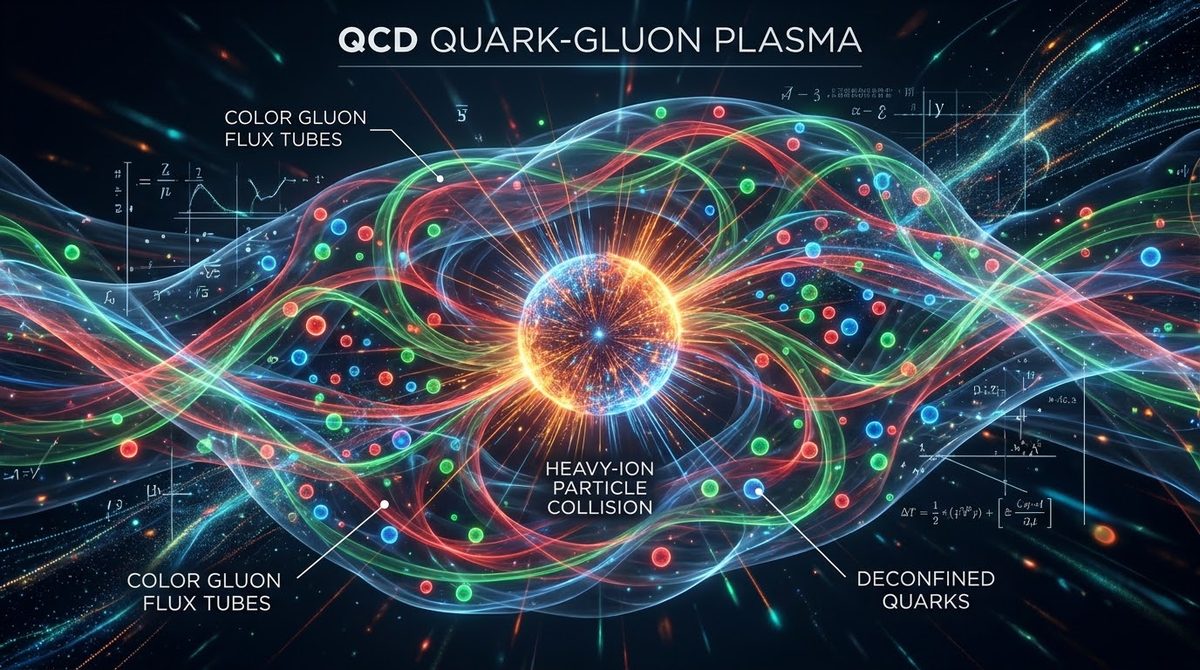
Illustration of a quark-gluon plasma: coloured flux tubes and free quarks streaming out of a heavy-ion collision.

QCD and heavy-ion physics

Nuclear matter at high temperature

Quantum Chromodynamics (QCD) is the fundamental theory describing how quarks and gluons interact, but its complex mathematics make it notoriously difficult to study under normal conditions. However, under the extreme temperatures and densities found in heavy-ion particle collisions (like those at CERN or RHIC) or within merging neutron stars, these particles break free to form a dense, deconfined plasma.

To decode the physics of these extreme environments, researchers are developing innovative mathematical frameworks that bridge complex quantum field theory with classical transport theory. By translating highly intricate quantum interactions — specifically through simplifications like Hard Thermal Loop (HTL) models and effective field theories — into more manageable transport equations, scientists can successfully simulate how these particle plasmas evolve dynamically over time. Ultimately, refining these theoretical tools makes it possible to calculate critical physical properties like energy loss and fluid dynamics, providing essential insights into the fundamental matter that drives the universe’s most extreme and energetic cosmic events.

Illustrations are artists’ impressions, not simulation output.